
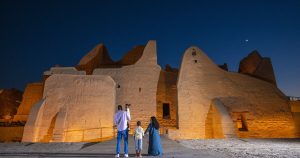

Time Travel in Old Riyadh: History and Architecture
Riyadh, the capital of Saudi Arabia, boasts a rich cultural and historical tradition dating back many centuries. Situated in the Yamāmah region on the ruins of the old city of Ḥajr, it is known as a hub of trading caravas across the Arabian Peninsula. The wells, palm groves, and verdant areas aided the city’s progress, and by the mid-17th century, Riyadh was characterised by a shallow valley along the Wadi Ḥanīfah. In 1920, the once small village, Riyadh, covering approximately only one square kilometre, had drastically grown to over 2000 square kilometres a century later. Today, the city boasts numerous gigantic, cultural and modern structures. Boasted with a rich tale of heritage and history, Riyadh stands as the finest country that reflects the humble beginning and rapid prosperity of Saudi Arabia. If you are seeking things to do in Saudi Arabia, let’s peek into some of the historical and ancient tales of the city by exploring the various cultural and ancient marvels of the land. Join us with Thrillark as we discover the hidden gems of Riyadh’s past. Masmak Fortress: Key Role in Unification The Masmak Fortress holds a profound historical significance and played a pivotal role in the unification of the province of Saudi Arabia in 1932. Erected in 1865 during the Second Saudi State, the fortress was a key defence base for Riyadh. After the collapse of the Second Saudi State in 1881, Abdulaziz, along with his 63 men, set off on a mission to reclaim the fortress in 1902. Despite the intensity of the conflicts, following the defeat and surrounding of Andulazis marked the beginning of the unification efforts. Since 1995, the Fortress has been converted into a museum showcasing one of the most important landmarks in Saudi Arabia. The museum encompasses several displays of antique and historical equipment like guns, costumes, and artefacts. Location: Qasr al-Masmak, Al Imam Turki ibn Abdullah ibn Muhammad, Dirah, Riyadh Opening Hours Mondays- Thursdays from 8:00 am to 12:00 pm and 4:00 pm to 9:00 pm. Fridays, from 4:00 pm to 7:30 pm; Saturdays, from 9:00 am to 12:00 pm and 4:00 pm to 7:30 pm The fortress is closed on Sundays Discovering the historical charm of Diriyah Diriyah, also spelt “Diriyah”, holds greater significance as the birthplace and capital of the first Saudi state. Located on the western edge of Riyadh, near the Highway, this ancient, tiny town played a crucial role in the formation of the kingdom. The city was left to rot for a century ever since it was destroyed by Ottoman in 1818. The city features diverse traditional mud-brick structures, defensive walls, historical buildings, mosques, and other cultural architecture from that time. In 2010, UNESCO recognised Diriyah as a World Heritage Site and emphasised the importance of preserving the heritage of the land. Apart from its historical significance, the Diriyah hosts various cultural events and festivals that invite tourists and residents alike. Location: Located on the north-western outskirts of the Saudi capital, Riyadh. Opening Hours: Monday to Wednesday: 10:00 am – 12:00 am Thursday to Saturday: 10:00 am – 1:00 am Sunday: 10:00 am – 12:00 am Experience the Traditional Souq Zal Market The Souq Zal Traditional Market is a captivating gateway into the traditional world of Riyadh, offering visitors a journey to the remarkable land to explore the city’s cultural fabric. Souq is one of the oldest traditional markets of Riyadh, carrying 100 years of history within its alleyways. Located about 5.4 km from Al-Murabba Historical Palace, the market area covers around 38,000 square metres. The market is renowned for its extravagant collection of antiques, rare coins, and vintage utensils. Location: Al-Dirah neighborhood, Riyadh Opening Hours: Sunday to Saturday from 3:30 pm to 10:30 pm. Daily, an antique auction takes place in the market, a few hours after afternoon prayer. National Museum of Saudi Arabia The hallways of the Saudi National Museum will take you on a journey beyond space and time. Situated in the neighbourhood of King Abdulaziz Palace, the museum opens us to the historical world of Saudi Arabia. Opened in 1419H, the museum spans a distance of 17,000 km and features a collection of 700 artefacts, including statues, scripts, and a unique collection of sculptures. The museum comprises eight galleries, such as the Man and Universe Gallery, which explores the origins of celestial and solar systems. If you want to gain insight into ancient civilization. Dig into the Ancient Arab Kingdom Gallery to learn about the life of Prophet Mohammad at Prophet Mission Gallery. Explore the urban development of Masjid Al Haram and Majid Al Nabawi in the Hajj and Two Holy Mosque Gallery. The museum also hosts seasonal exhibitions and activities like Photography corners and festive moments, creating delightful and enriching hours for the visitors. Location: located in the al-Murabba neighborhood of Riyadh, Saudi Arabia Opening Hours: Monday to Wednesday: 9:00 am – 9:00 pm Thursday: 9:00 am – 11:00 pm Friday: 1:00 pm – 11:00 pm Saturday: 9:00 am – 9:00 pm Delve into the historical Thumaira Gate This historical gate is living testament to its significant role in Saudi Arabia’s history. Located in the Ad Dirah in Riyadh, it was once part of the city wall built by King Abdul Aziz after conquering Riyadh. Thus, the gate symbolises a pivotal period, where Riyadh became the capital city of the newly formed Kingdom of Saudi Arabia. It also holds significance among the nine gates depicted in 1922 Riyadh, scripted in Harry St. John’s (1922) book, The Heart of Arabia. The sand-coloured gate features a small turret, allowing visitors to climb over it and experience the modest views over the Souk area. Location: Ad Dirah section of Riyadh, Saudi Arabia. Opening hours: Open from 9:00 am to 4:30 pm daily. It is recommended to visit the gate between 10:00 am and 3:00 pm and avoid visiting during prayer times. Sheikh Muhammad Ibn Abdul Wahhab Mosque Located in the heart of Riyadh, the Sheikh Muhammad Ibn