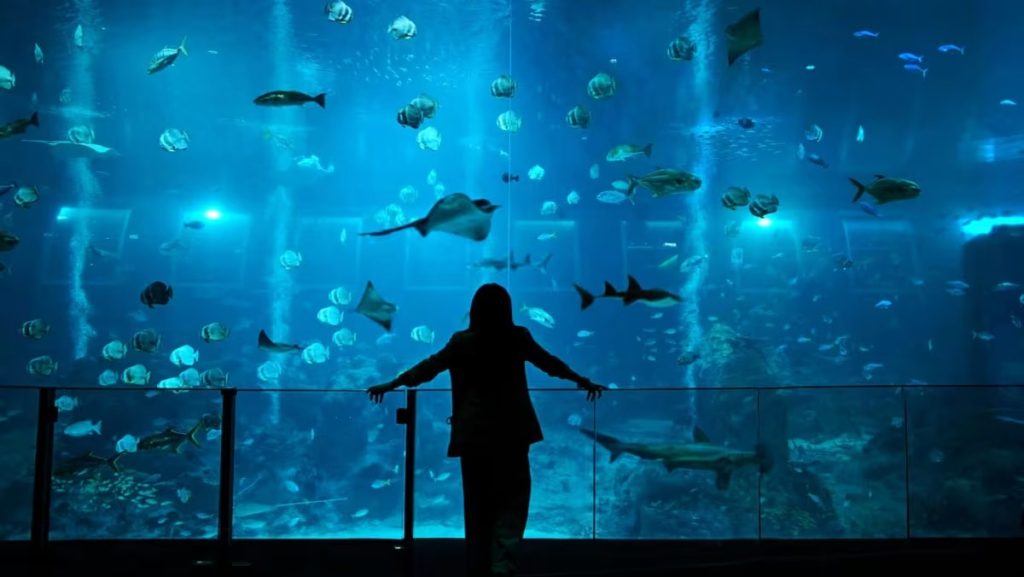
Imagine standing in front of an 18-million-litre tank while three manta rays glide silently past your face. That’s not a screensaver – that’s a Tuesday at the Singapore Oceanarium.
The old SEA Aquarium closed on 30 April 2025 after 12 beloved years, and what replaced it is honestly in a different league. Three times larger, 22 immersive zones, 40,000+ marine creatures, and a narrative so well-designed it feels like walking through a Netflix documentary.
Welcome to the best aquarium experience in Southeast Asia. You’ll definitely want to make some space for it on your Singapore itinerary.

What Is the Singapore Oceanarium?
Sitting inside Resorts World Sentosa, the Singapore Oceanarium is now one of the largest aquariums on the planet, ranking just behind SeaWorld Abu Dhabi and Chimelong Ocean Kingdom globally.
But raw size isn’t the flex here. What makes this place genuinely special is the story it tells: starting from a single drop of water, moving through prehistoric seas, coastal Singapore, the open ocean, the crushing deep, and finally arriving at a message about the future of our planet. It’s got a beginning, middle, and end – and every zone earns its place.
It’s also not just a pretty fish tank. The Oceanarium operates as a legitimate ocean research and conservation institute, housing critically endangered species like the bowmouth guitarfish and the sunflower sea star.
The whole building runs mostly on solar power and carries a Green Mark Platinum Zero Energy certification. So you’re not just gawking at sea creatures; you’re funding the science that keeps them alive.
Think part aquarium, part science museum, part immersive art installation. Except the art is alive and occasionally has very sharp teeth.
Plan Your Visit Without the Headache
The Oceanarium opens daily at 10 am and closes at 7 pm, with last admission at 6 pm. The golden rule? Arrive when the doors open. Midday is chaotic with tour groups, school trips, and every family on Sentosa converges between noon and 3 pm.
If mornings aren’t your thing, weekday afternoons after 4 pm are your next best bet. Peak seasons like the June school holidays, November, and December are best navigated with advance tickets and early arrivals.
Getting there is dead simple. Hop on the Sentosa Express from VivoCity to Resorts World Station. It’s a 2-minute walk from there.
Driving? Park at B1 East Zone in the RWS car park. You can also walk across the scenic boardwalk from VivoCity if you’re in the mood.
Once inside, expect nearly 5km of walking across all 22 zones, so comfortable shoes are non-negotiable. Throw a light jacket in your bag too. The deep-sea zones run cold enough that you’ll notice.
Budget at least 2–3 hours for a breezy visit,3–4 hours if you’ve got curious kids in tow, and a full 4–5 hours if you’re catching feeding shows and doing add-on experiences.
Download the Singapore Oceanarium app before you go. It unlocks an AR experience in Shark Seas, holds the zone map, and has surprised visitors with free add-ons during promotional periods.
All 22 Zones at Singapore Oceanarium Explained
The Singapore Oceanarium groups its 22 zones into six chapters, each telling a distinct part of the ocean’s story. So let’s get into it.
In the Beginning
- Drop of Water is your opening act, and it sets the mood perfectly. Look up at the domed ceiling, designed to mimic a suspended water droplet, and watch millions of plankton swirl and pulse in a mesmerizing projection that makes the invisible world enormous. It’s the ocean at its most fundamental level, and it’s genuinely beautiful. Don’t rush past it.
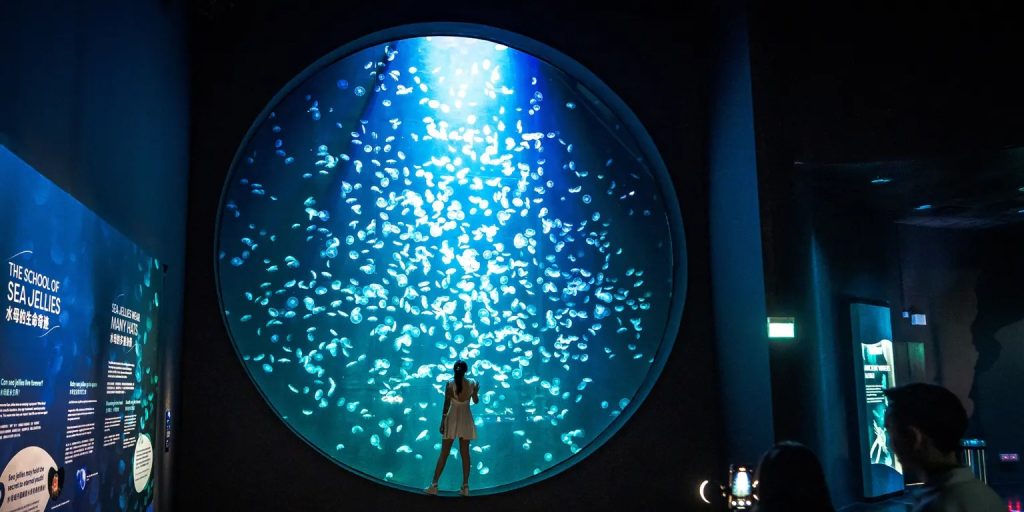
- Ocean Wonders is where the jaw-dropping begins, and it happens fast. At the heart of this zone sits one of the world’s largest Kreisel habitats, home to thousands of moon jellies pulsing and free-floating under immersive, ethereal lighting. Cylindrical tanks surrounding it give you 360-degree views of Atlantic sea nettles, fried-egg sea jellies, and more. Every jelly here is bred in-house by the Oceanarium’s own aquarists, which means rotating displays and a visit that genuinely never repeats itself.
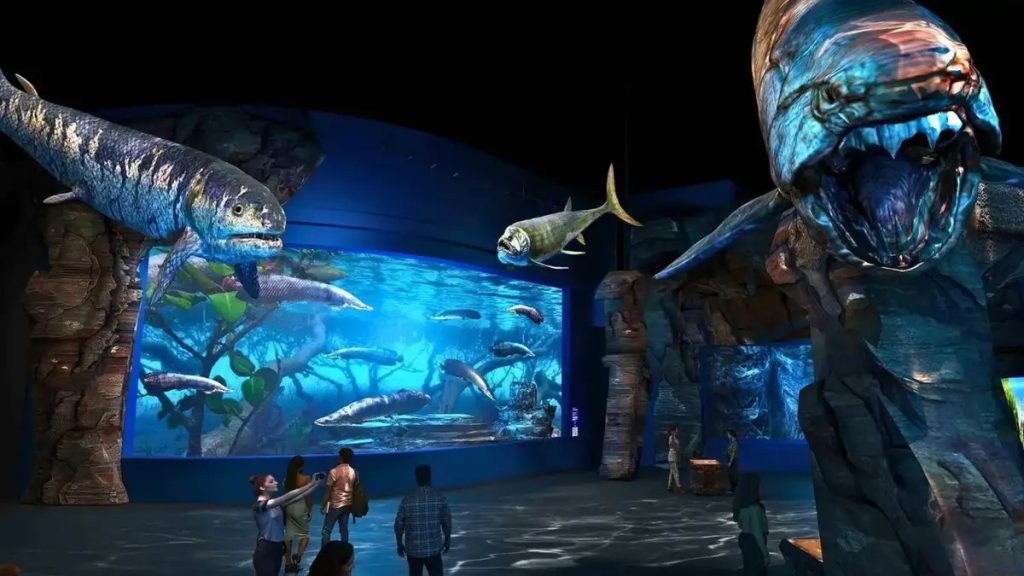
- Ancient Waters is prehistoric ocean life, brought terrifyingly back to life. Life-sized animatronics of the armour-jawed Dunkleosteus and the apex predator Xiphactinus tower above you, while fossil displays and interactive discovery points let you actually touch history. Living fossils like the Australian lungfish, arapaima, horseshoe crab, and epaulette shark remind you that some things from that ancient world never left.
- Conquering Land follows with the evolutionary leap from water to land, featuring live axolotls, poison dart frogs, and digital recreations of extinct species like the Eryops and Diplocaulus using the Pepper’s Ghost effect. Equal parts eerie and awe-inspiring.
At the Surface
- Spirit of Exploration is where maritime history walks into the Oceanarium uninvited and completely steals the show. At its heart is the Jewel of Muscat, a full-scale reconstruction of a real 9th-century Omani dhow that once navigated the vast Indian Ocean.
Fun fact: the entire Oceanarium was built around this ship. Above the vessel, Pier Adventure’s suspended web (separately ticketed) invites you to step off solid ground for a daring new perspective from above. Right next to it, Explorer’s Nook Café serves marine-themed pastries and curated lifestyle products. This is your first proper rest stop of the journey. - Singapore’s Coast is a living mangrove ecosystem right inside the building, and it’s one of the most interactive zones in the whole oceanarium. Encounter native species like the Archerfish and Barred Mudskipper in live habitats, while projection mapping brings other coastal animals to life, scuttling across rockwork in a mesmerizing display of movement and light.
Head to the discovery pools for a hands-on moment – the brush of a knobbly sea star, the ripple of a spotted seahorse, or the famous cleaner shrimp experience at the rock pool where the little guys swarm your hands immediately. Strange, ticklish, and completely unforgettable.
Sunlight
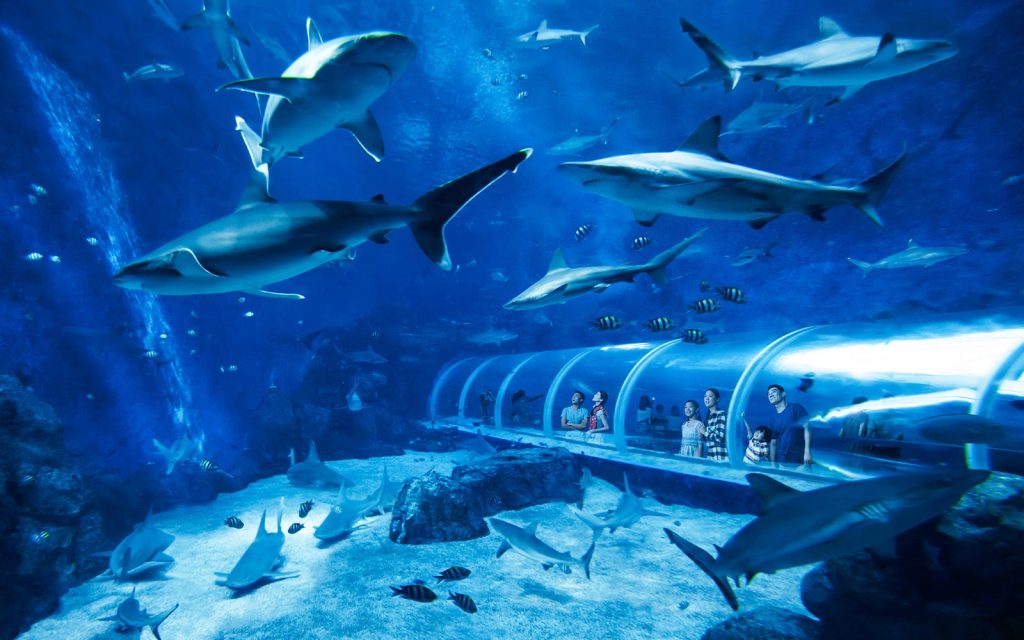
- Shark Seas brings you face-to-face with some of the ocean’s most misunderstood animals and does it brilliantly. Walk through the Shark Tunnel as Sand Tiger Sharks, Scalloped Hammerheads, and Sandbar Sharks glide overhead and all around you, with lighting and soundscapes that mirror the ocean’s sunlit zone. Stand at the large viewing panel to observe their movement up close. Open the Singapore Oceanarium app here for an AR experience that uncovers the complexities of shark reproduction. It is genuinely fascinating, and it completely changes how you see these creatures.
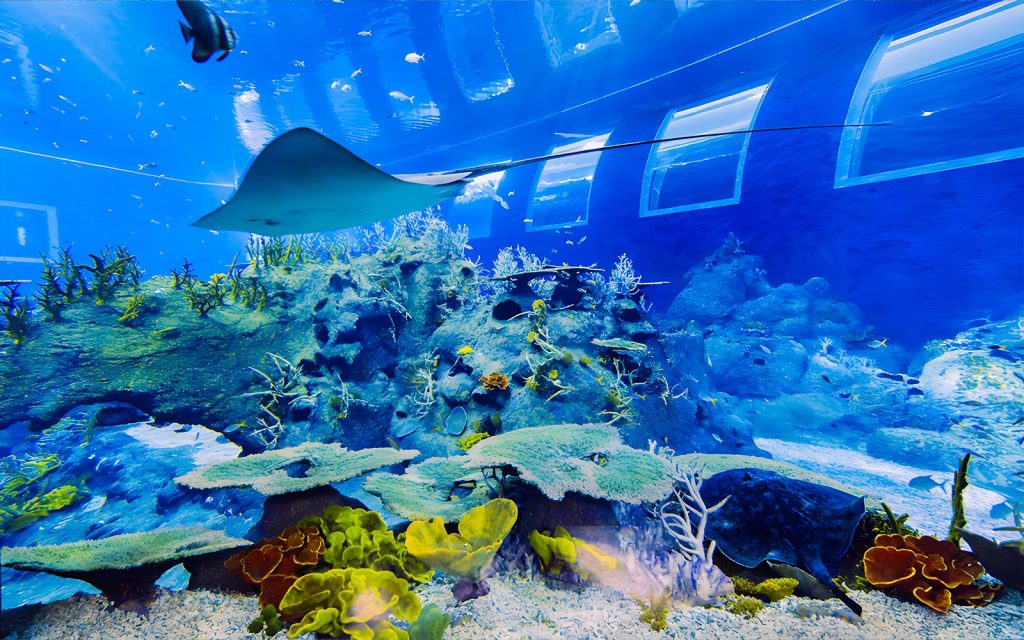
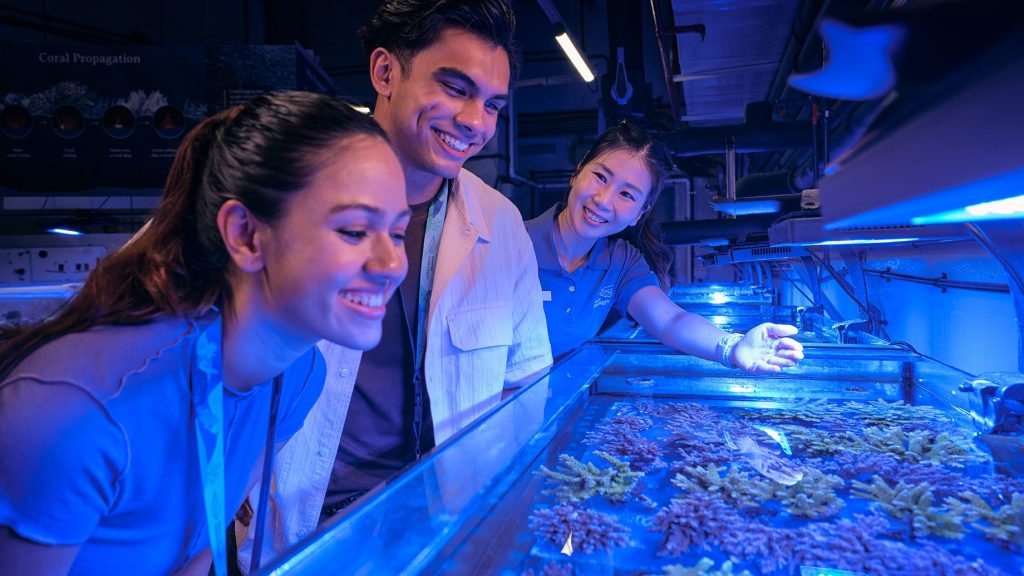
- Coral Gardens is a riot of colour and ecological complexity. Hard and soft corals share space with giant clams, all playing their part in one of the ocean’s most vital ecosystems. The Moray Eel crawl tunnel is the standout moment – get low, crawl through, and watch these elusive animals weave through rock formations just inches from your face.
- Reef Animals and Kelp Forest follows, with sun rays filtering through swaying kelp fronds and species like the weedy seadragon and dog-face puffer darting through the reef. You can also glimpse into the aquarist lab where hatchlings from in-house breeding programmes are nurtured and plankton cultured. You can also book a separate ticketed experience for actual inside access.
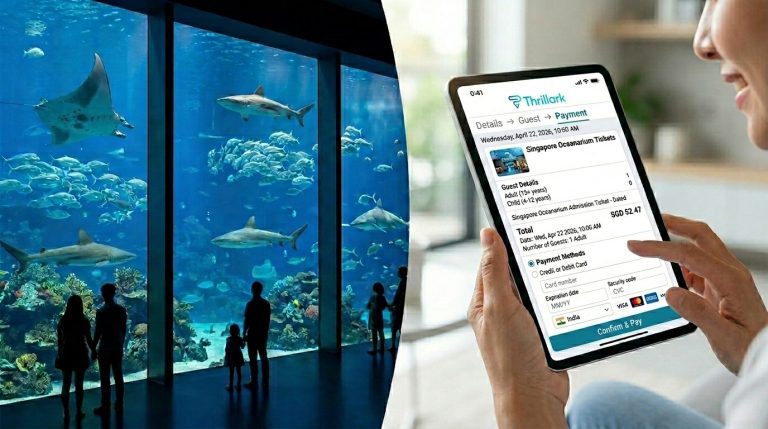
- Open Ocean is the crown jewel, the moment that makes the entire ticket price feel like a bargain. The Oceanarium’s largest habitat and viewing panel stretches across the space in an immense window into endless blue. You get to see manta rays, spotted eagle rays, and zebra sharks gliding past in breathtaking slow motion. It creates the illusion of being fully submerged in the open sea. Ocean Bites sits right here for anyone who wants to grab a snack and simply watch for a while. You could spend an hour at this panel and not feel a second of it.
Into the Deep
- Open Ocean Currents bridges the sunlit world above and the darkness ahead. Schools of fish shift and swirl through projection mapping that mirrors the ocean’s natural rhythms, while the Sargassum habitat introduces species like the Sargassum fish, mysid shrimp, and Japanese bigeye – all uniquely adapted to life on the move.
The standout moment here is the “Garbage Patch” art installation, which traces the journey of a single discarded plastic bottle drifting across the ocean. Brief, powerful, and impossible to ignore. - Migrators split into two habitats that reveal the ocean’s great travelers. Vertical Migrators show species that descend by day and rise by night, including the bioluminescent Japanese pineapplefish, whose glow likely helps it communicate and camouflage in darkness.
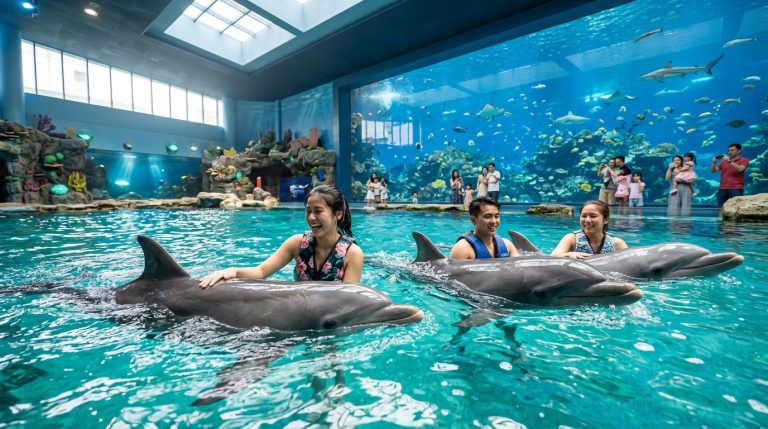
Horizontal Migrators puts Indo-Pacific Bottlenose Dolphins and other long-distance wanderers center stage, navigating vast ocean distances on pure instinct. Every migration is a story of survival and resilience. After this chapter, Tidal Trove (the mid-journey gift shop) and Tide Deli (artisan gelato, light bites) are perfectly placed for a break. - Benthos takes you to the seafloor of shallow seas, where green morays weave through rocky crevices, and Tasmanian giant crabs navigate the terrain with surprising purpose. A cylindrical habitat is full of Banggai cardinalfish and yellow tangs, each playing their role in the underwater community.
The Art-quarium interactive touch table lets you mix traits to design your own digital fish. Kids go wild for it, and adults absolutely do too, just quietly. - Artificial Habitats closes this chapter with a walkthrough of a sunken shipwreck tunnel where Indo-Pacific Leopard Sharks, Blotched Fantail Rays, and Bonnethead Sharks glide through the wreck’s remains. Artifacts from the real Bakau Wreck are displayed throughout, showing how human history and marine ecology are permanently intertwined.
The Abyss
- Deep Ocean Exploration opens with one of the Oceanarium’s most striking physical set pieces – a life-sized replica of a Triton deep-sea submersible, the kind of vessel built to descend into crushing darkness. Immersive projections recreate reality deep-sea expeditions and long-lost shipwrecks around you, bringing the last great unexplored frontier of our planet to life. It’s part science exhibit, part adventure story.
- Life in the Deep plunges you into a world without sunlight where everything glows. Preserved specimens of deep-sea species are displayed with lighting effects and floor projections of bioluminescent plankton that flicker like stars underwater. The Singapore Oceanarium app unlocks a VR experience here that brings the specimens to life. It is definitely worth opening.
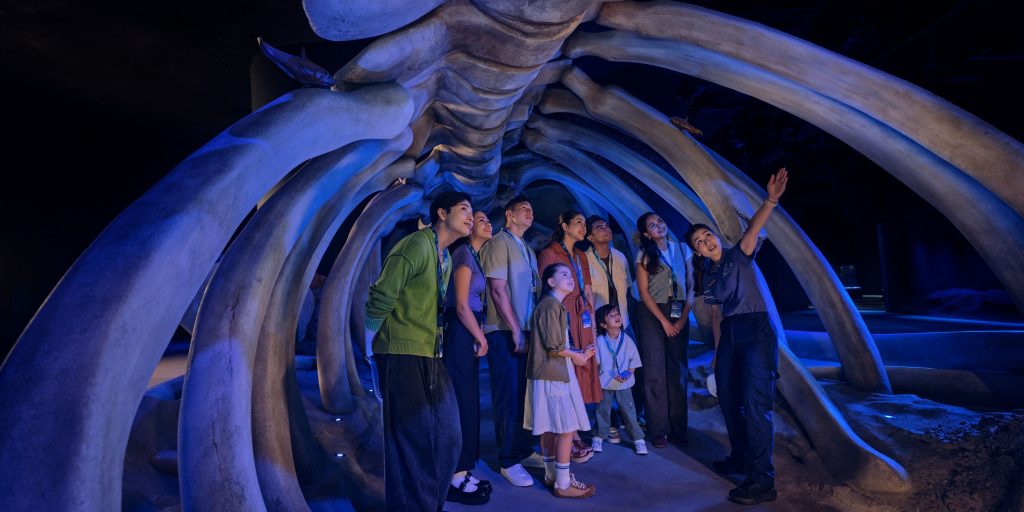
- Whale Fall and Seamount is the emotional center of the entire Abyss chapter. A whale fall skeleton rests on the “seafloor,” surrounded by hydrothermal vent simulations showing how even a whale’s death sustains life for decades. Japanese isopods, deep-sea Akaza prawns, and the Australian ghost shark all thrive here. The atmospheric lighting and soundscapes make this one of the most quietly moving zones in the building.
- Trenches closes the abyss with a large-scale projection of real deep-sea expedition footage inside ocean trenches that stretch deeper than Mount Everest is tall. There are no live animals here. Nothing can survive abyssal conditions in a tank, but the immersive scale of the projection turns it into something genuinely cinematic. Step into the unknown and all that.
A New Horizon
- Ocean’s Future is the most visually arresting zone in the building and also the most urgent. An anamorphic illusion projects collapsing ice shelves directly in front of you. Beyond it, a live habitat with lionfish imagines a warming ocean future where invasive species have taken over a reef stripped of colour, balance, and life. It’s a glimpse of what could be. Beautiful in the most unsettling way possible.
- Hallway of Hope is where the Oceanarium exhales, and so do you. The challenges facing our oceans are front and center, but so are the remarkable stories of communities and researchers turning the tide through marine protection initiatives, coral restoration, and conservation breakthroughs. It’s honest about the scale of the problem and genuinely optimistic about the solution. Make your pledge before you leave. Scan the QR code and watch it appear live on the board. After 22 zones, you’ll mean every word of it.
The Singapore Oceanarium Store sits at the exit, open to the public without a ticket – axolotl plushies, the Miffy x Oceanarium collaboration, eco-friendly brands, and ocean-inspired merchandise in a space that’s far more beautiful than any gift shop has the right to be.
Feeding Shows & When to Be Where
The Singapore Oceanarium runs a solid lineup of daily presentations and feeding sessions that genuinely elevate the visit. The best ones fill up fast, so knowing what’s on before you arrive makes a real difference.
The Sea Jelly Secrets talk at Ocean Wonders is a great free session where presenters explain moon jelly biology and care while a live feeding happens in real time. If you want a deeper, more intimate jelly experience, the Animal Spotlight: Sea Jellies programme takes you behind the scenes at the Aquarist Lab. Sessions run at 11:15 am, 12:00 pm, and 3:00 pm, though this one is separately ticketed.
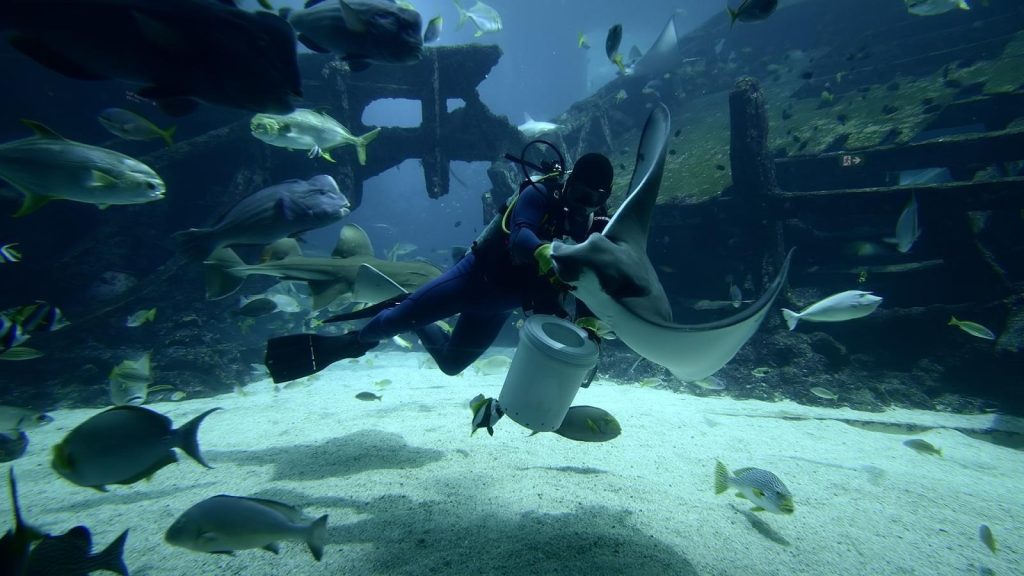
The Open Ocean Dive Feeding is pure spectacle and worth planning your entire afternoon around. Here, divers descend into the 18-million-litre tank and hand-feed Manta Rays, spotted eagle rays, and zebra sharks while narrating the action live.
The Shark Seas Dive Feeding on Tuesdays and Thursdays, lets you watch divers interact with reef sharks and moray eels up close, while Sensational Sharks runs daily at Shark Seas for a presenter-led deep dive into shark behaviour and ecology.
There’s also a Curious about Corals session at Coral Gardens and the Open Ocean Discovery Presentation twice daily. Check the schedule board at the entrance when you arrive, as timings can vary by day.
One pro tip that most visitors miss: the Manta Mascots make daily appearances at the Entry Plaza at 10 am, the Open Ocean Habitat at 3 pm, and the Shipwreck at 6 pm. They’re a genuinely fun photo opportunity, especially if you’re visiting with kids.
For the best possible day, arrive at 10 am, browse the opening zones at your own pace, position yourself at Open Ocean well before the afternoon dive feeding, and check the daily schedule board for whatever best matches your interests.
Always verify current timings on the official Singapore Oceanarium website before your visit, as schedules are subject to change.
Add-On Experiences That Are Actually Worth It
Ocean Dreams is the one that makes people audibly gasp when they hear about it. It’s an overnight glamping experience where you sleep in a sleeping bag directly in front of the open ocean viewing panel. You see manta rays and sharks gliding silently past while you drift off.
Spots are extremely limited, it sells out months in advance, and it is absolutely as magical as it sounds. Book the moment you decide you want it.
The beginner PADI dive programme lets you enter an actual exhibit tank alongside marine life, with zero prior experience required. It’s one of the most unique dive opportunities in Singapore and far more accessible than most people assume. The team handles everything.
Expert-led guided tours of the jelly or coral zones offer behind-the-scenes access and one-on-one time with specialists who know these animals better than anyone.
For younger visitors, the Junior Ocean Fossilist Workshop (ages 7–12) is a hands-on fossil-uncovering session with real specimens. It’s the kind of experience kids talk about for years.
The Citizen Science programme connects curious adults with actual oceanarium researchers working on intertidal studies along Singapore’s coastline.
These aren’t gimmicks. They’re the kind of experiences that turn a good day out into something genuinely meaningful.
Where to Book Your Singapore Oceanarium Tickets
The safest and most reliable place to book is always the official Singapore Oceanarium website. You’ll get real-time availability, accurate ticket categories, and direct access to any promotions the Oceanarium is running.
Advance booking is strongly recommended, particularly on weekends and during school holiday periods when walk-in queues move at a slow pace. Seriously, don’t risk it.
For great deals, combo packages, and a smoother booking experience, Thrillark is well worth checking out.
Thrillark provides the standard Singapore Oceanarium tickets and also offers combo deals like Singapore Oceanarium + Universal Studios Singapore tickets, Singapore Oceanarium + Adventure Cove Waterpark tickets, and Singapore Oceanarium + Madame Tussauds tickets at rates that make the math work in your favour.
If you’re building a full Sentosa or RWS day, grabbing a combo through Thrillark can save you a meaningful amount and spare you the hassle of booking each attraction separately.
One last thing before you confirm your booking: download the Singapore Oceanarium app first. It unlocks the AR experience in Shark Seas, holds the full zone map, and has historically offered exclusive app-linked perks during promotional windows. It takes two minutes to download and has a decent chance of saving you money or unlocking something extra – a no-brainer either way.
Honest Verdict – Is It Actually Worth It?
For families with young kids, this is a straight-up five-star experience. The interactive zones, the feeding shows, the Art-quarium, the cleaner shrimp rock pool, and the sheer scale of the open ocean panel make it one of the best family days out anywhere in Singapore. The Oceanarium is also remarkably well-designed for prams, with ramps and elevators throughout all 22 zones.
For couples, solo visitors, and marine enthusiasts, the experience is rich and genuinely thought-provoking, especially if you move slowly through the deep-sea zones and let the conservation message land. The production quality throughout is high, the narrative arc is smartly constructed, and zones like Whale Fall and Ocean’s Future offer the kind of emotional resonance you don’t usually get from an aquarium.
The final few zones (Trenches especially) lean heavily on projections rather than live animals, which some visitors find slightly anticlimactic after the biodiversity of the earlier zones. It’s scientifically accurate. Nothing lives at abyssal depth in a tank, but it’s worth knowing in advance so you’re not caught off guard. Everything before that point? Absolutely earns the price of admission.
FAQs About the Singapore Oceanarium
Browse by themes
Singapore Oceanarium: Nearby Attractions