Venice was built in a lagoon by people fleeing barbarians and ended up becoming one of the most powerful maritime republics in history. It should not have worked. The engineering, done without steel, without concrete, and without any of the tools we consider essential for modern construction, involved driving millions of wooden piles into the silt of an Adriatic lagoon, waiting for them to petrify, and building a city on top.
That city then controlled the spice trade between Europe and the East for three centuries, built the palaces that line the Grand Canal, invented the ghetto, pioneered modern opera, produced Titian, Tintoretto, Veronese, Vivaldi, and Casanova, and declined gracefully into the most beautiful ruin of imperial ambition anywhere on Earth.
You are going to fall completely in love with it. Give it three days at minimum. Take the early vaporetto, get lost in the calli (the narrow lanes that do not appear on any map accurately), eat the cicchetti (small bar snacks) at the bacari (wine bars) that fill up every evening with locals who have been doing exactly this for their entire adult lives.
Venice is not a museum. The Municipality of Venice has around 250,000 residents overall, though fewer than 50,000 of those live in the historic island centre where visitors spend their time, with the majority based on the mainland in Mestre and Marghera.
The visitors who treat the islands as something to photograph rather than something to inhabit are missing the actual experience entirely.
Venice City Essentials
Entry Requirements for Venice
EU and Schengen Area citizens can travel to Italy without any visa requirements. Citizens of the US, UK, Canada, Australia, and most Western countries can visit without a visa for up to 90 days in any 180-day Schengen period.
Indian nationals require a Schengen visa from the Italian Embassy before departure. The EU’s ETIAS pre-travel authorization for visa-exempt non-EU nationals is being progressively rolled out. Don’t forget to check out travel.ec.europa.eu before booking.
Venice Day Visitor Contribution: Venice now charges a day visitor contribution (€5 to €10 depending on the date and period) for day-trippers who arrive without a hotel booking. Visitors staying overnight are exempt. Check the current rates and dates at cda.venezia.it before your visit.
Getting There and Getting Around
Venice Marco Polo Airport (VCE) is 12 km north of Venice on the mainland. The most atmospheric arrival is by Alilaguna water bus, which connects the airport directly to various points in Venice by boat across the lagoon in about 75 minutes.
ACTV buses connect to Piazzale Roma (Venice’s bus terminus) in about 25 minutes, and taxis also run to Piazzale Roma. From Piazzale Roma, you are in Venice, and the only transport is on water or on foot.
By train: Venice Santa Lucia station sits at the northwestern end of the historic centre, directly on the Grand Canal. Trains connect Venice to Milan (about 2.5 hours), Florence (2 hours), Bologna (1.5 hours), and Rome (about 3.5 hours). High-speed Frecciarossa and Italo services run frequently.
The Eurail Global Pass covers rail travel across Europe, including all of these Italian routes.
Getting around Venice:
There are no roads, no cars, no bicycles, and no motorbikes in the historic centre of Venice. Everything moves by water or on foot.
- Vaporetto (water bus): The ACTV vaporetto network covers all of Venice’s islands and the Grand Canal, running frequently from around 5 am to midnight with reduced night services after that. The most important lines are Line 1 (slow, stops at every Grand Canal landing stage), Line 2 (fast, limited stops on the Grand Canal), and the lines connecting Venice to Murano, Burano, and the Lido. A single ticket covers 75 minutes of travel. The Venice Vaporetto Pass covering 24, 48, or 72 hours of unlimited travel is available through Thrillark and is the most cost-effective option for any visitor making more than a couple of journeys.
- Gondola: The iconic black wooden boat of Venice is primarily a tourist experience rather than a practical transport mode. A standard gondola ride covers 30 to 40 minutes through the smaller canals rather than the Grand Canal. Prices are fixed by the city, and keep in mind that evening rides cost more than daytime. The experience is genuinely romantic and genuinely overpriced and worth doing at least once.
- Traghetto: This is the public gondola service that crosses the Grand Canal at several points between the main bridges. It is a cheap, practical, standing-only crossing that locals use daily.
- Walking: This is the most important and most rewarding way to experience Venice. The city rewards getting lost. Every wrong turn eventually leads somewhere worth being.


St. Mark’s Square and the Basilica
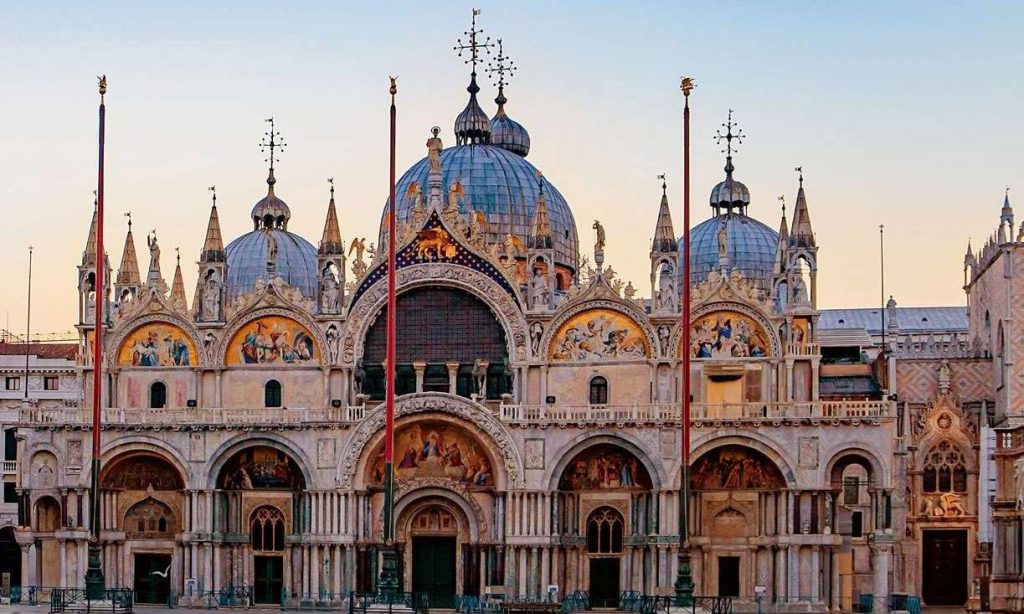
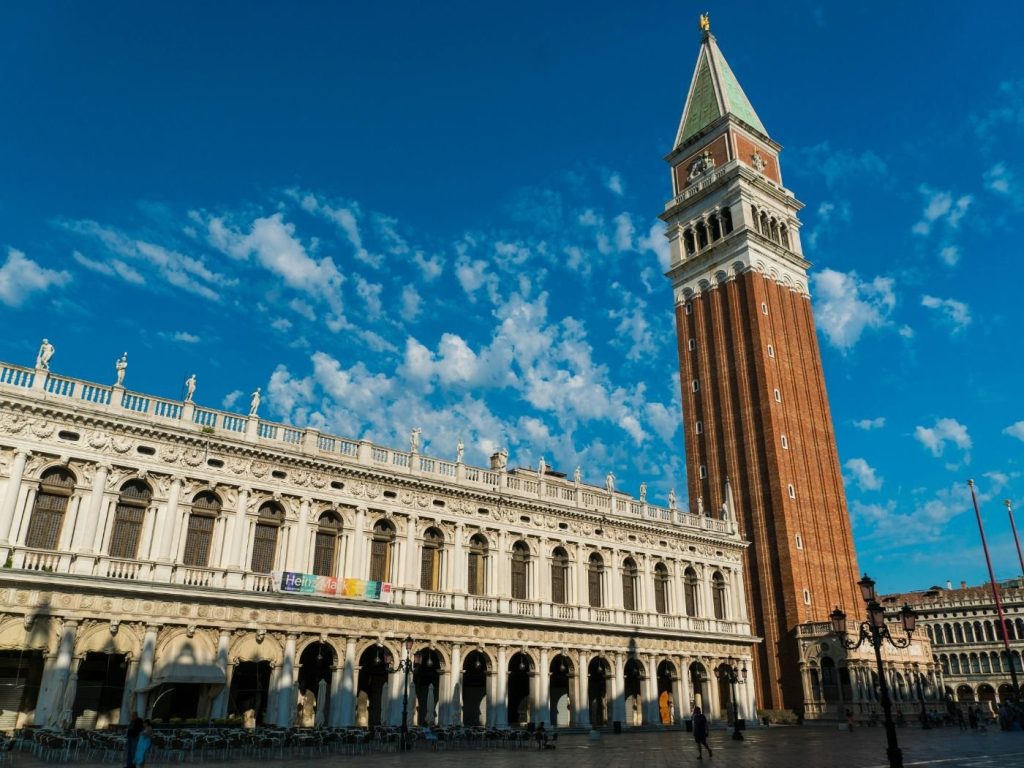
Every journey through Venice eventually leads to St. Mark’s Square (Piazza San Marco), and it deserves the reputation. Napoleon called it “the finest drawing room in Europe,” which is not something Napoleon said often about things he did not intend to annex. The piazza is flanked on three sides by the Procuratie Vecchie and Procuratie Nuove, the former administrative buildings of the Venetian Republic, and on the fourth by the Basilica di San Marco.
St. Mark’s Basilica (Basilica di San Marco) is the most important building in Venice and one of the finest examples of Byzantine architecture in the Western world. Construction began in 830 AD to house the relics of St. Mark, stolen from Alexandria by Venetian merchants.
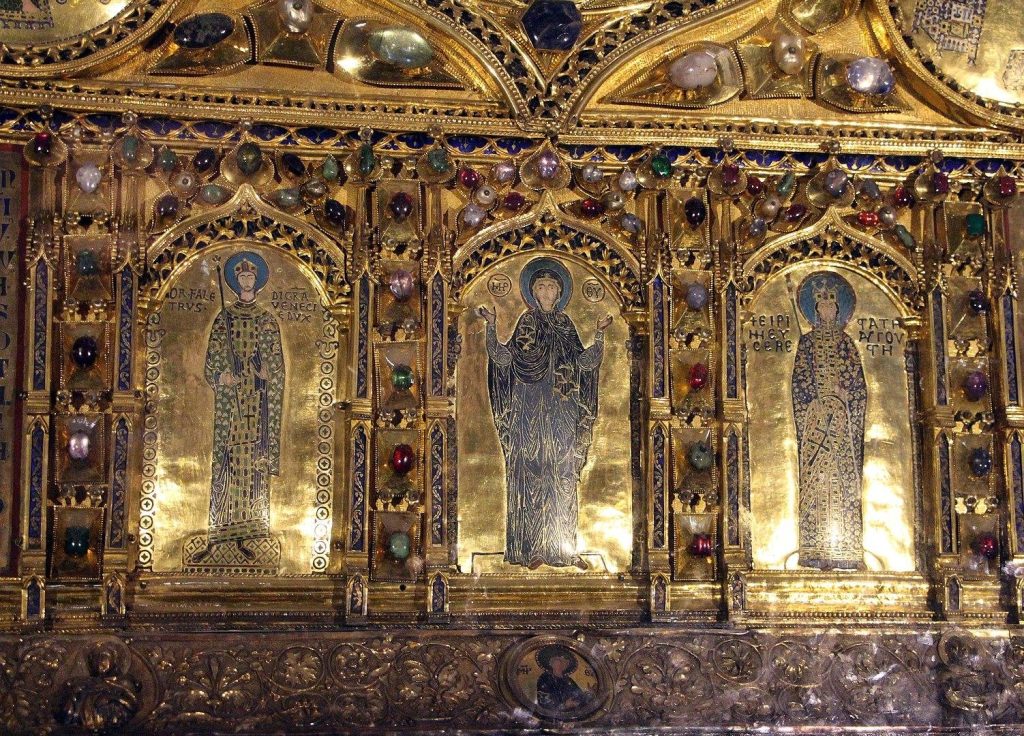
The current building was substantially completed by 1094 and decorated over subsequent centuries with mosaics, marble, and treasures plundered from Constantinople during the Fourth Crusade of 1204. The interior covers 8,000 square metres of gold mosaic on the walls and ceiling, and the Pala d’Oro (the golden altarpiece behind the high altar) is one of the finest examples of Byzantine goldwork in existence, set with 1,927 gems.
Entry to the basilica requires a standard admission ticket (introduced to manage crowd numbers and funding), with additional separate tickets for the Pala d’Oro, the museum and loggia, and the Campanile. Book skip-the-line access in advance because the queues at peak season are long.
From the Basilica, the Campanile di San Marco (St. Mark’s Bell Tower) rises 98.6 metres above the piazza. The current tower is a 1912 reconstruction of the original, which collapsed in 1902 with sufficient grace that it damaged almost nothing around it. The lift to the top gives the finest view over Venice and the lagoon available from any structure in the city.


Doge’s Palace
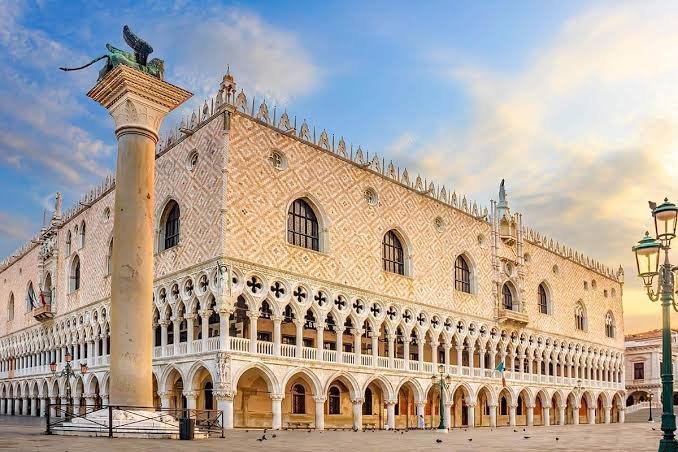
Directly beside the Basilica, connected by the Bridge of Sighs that spans the narrow canal between them, stands the Doge’s Palace (Palazzo Ducale), the seat of Venetian government and justice for nearly a thousand years. It is a building of extraordinary Gothic architecture in pink Verona marble and white Istrian stone that manages to look delicate at the scale of a government headquarters.
The interior covers the full apparatus of Venetian power with the Senate Chamber, the Council of Ten’s meeting room, the armoury, and the Great Council Hall, the largest room in the world in its time when constructed in the 14th century, whose ceiling is covered by Tintoretto’s Paradise, the largest oil painting in the world at 22 by 7 metres.
The Bridge of Sighs connects the palace to the New Prisons, through which condemned prisoners passed from their final judicial interview, allegedly sighing at their last view of Venice through the bridge’s small windows.

The Grand Canal
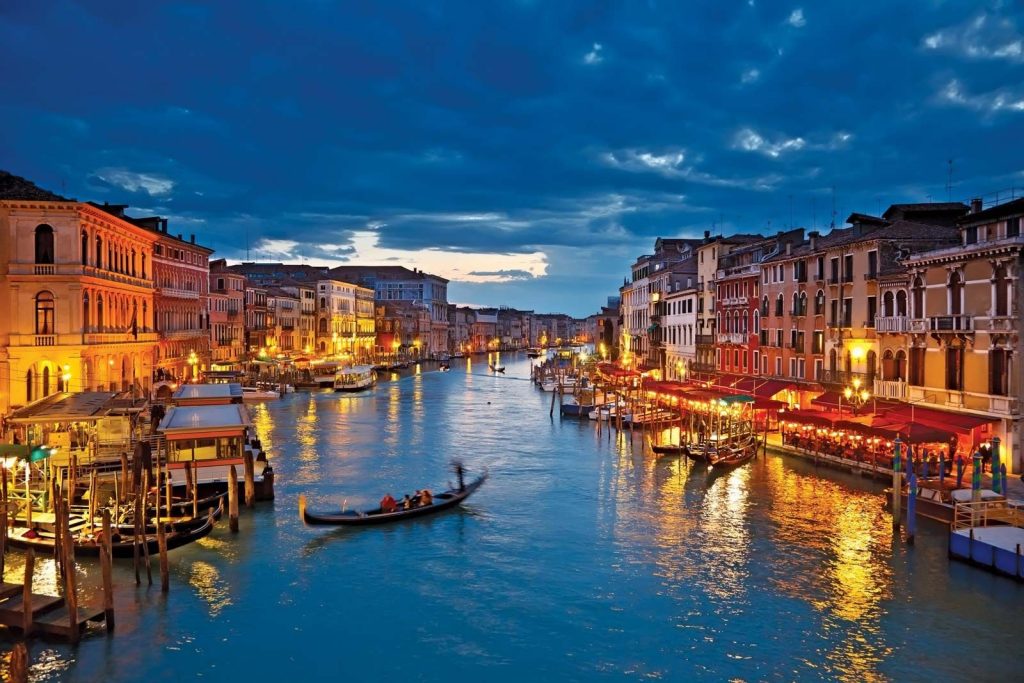
The Grand Canal is the main waterway of Venice, running in a reverse-S shape for about 3.8 km through the heart of the city from the Santa Lucia train station to the Punta della Dogana at the tip of the Dorsoduro. It is lined on both sides with over 170 palazzi built between the 13th and 18th centuries, the accumulated physical expression of Venetian mercantile wealth and aristocratic competition in stone, brick, and marble.
The best way to see the Grand Canal is on the vaporetto Line 1, from the station end to St. Mark’s Square or in reverse, taking the slow route that stops at every landing stage and lets you sit on the deck looking up at the palaces passing at eye level. This journey takes about 45 minutes and costs the price of a vaporetto ticket. It is one of the finest transport journeys in the world.
The Rialto Bridge (Ponte di Rialto) at the midpoint of the canal is the oldest of the four bridges that cross it, completed in 1591 to a design by Antonio da Ponte after proposals by Michelangelo and Palladio were rejected in favour of this more commercial structure with its double row of shops. The view from the bridge up and down the Grand Canal in both directions is one of the most frequently photographed in the world and most beautiful in the early morning before the foot traffic peaks.
The Grand Canal, St. Mark’s Square and Basilica, and Rialto Bridge Tour combines a guided journey of all three in a single experience, with commentary providing the historical and architectural context that makes the canal’s extraordinary procession of palaces comprehensible.
The Neighbourhoods of Venice
Venice is divided into six sestieri (districts), each with its own character, and exploring beyond St. Mark’s Square and the Rialto reveals the city that residents actually live in.
Dorsoduro on the southern bank of the Grand Canal is the most pleasant area to base yourself. It is quieter than San Marco, with the Zattere promenade along the Giudecca Canal for morning coffee watching the cruise ships navigate the channel, the Campo Santa Margherita (the most social piazza in Venice, lined with students and bacari), and two of the most important museums in Venice: the Accademia and the Peggy Guggenheim.
Cannaregio in the north is the most residential sestiere, where the Jewish Ghetto (the original ghetto, established in 1516, and the etymology of the word as used globally today) is found on a small island locked at night by the Venetian authorities. The ghetto has the tallest buildings in Venice, a result of the community being forced to build upward when expansion outward was prohibited.
Castello to the east contains the Arsenale, the massive former shipyard of the Venetian Republic where warships were produced in a production line process (the world’s first) that could outfit a galley in a single day at peak operation. The Arsenale is now primarily used for the Venice Biennale.
The Peggy Guggenheim Museum
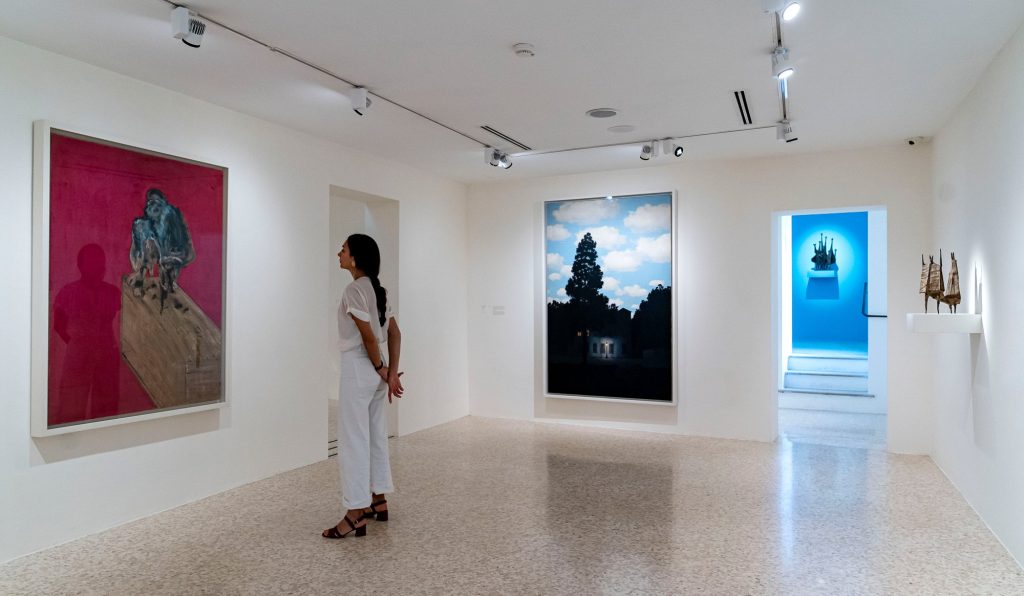
From the Doge’s Palace, crossing to the other side of the Grand Canal by traghetto or walking south through Dorsoduro brings you to one of the most important art collections in Europe, installed in one of the finest settings of any museum in the world.
The Peggy Guggenheim Museum on the Grand Canal in Dorsoduro is housed in the Palazzo Venier dei Leoni, the only low building on the Grand Canal (it was never completed above the ground floor, giving it the nickname “palazzo nonfinito”).
American heiress Peggy Guggenheim lived here from 1949 until her death in 1979 and assembled one of the finest Surrealist and Abstract Expressionist collections in existence: Picasso, Braque, Duchamp, Kandinsky, Mondrian, Pollock, Rothko, Ernst, Dalí, and Magritte in the rooms of her former home, with Marino Marini’s Angel of the Citadel on the terrace directly above the Grand Canal.
The collection is both intellectually serious and deeply personal, reflecting a woman who bought what she loved rather than what was recommended.

La Fenice Opera House
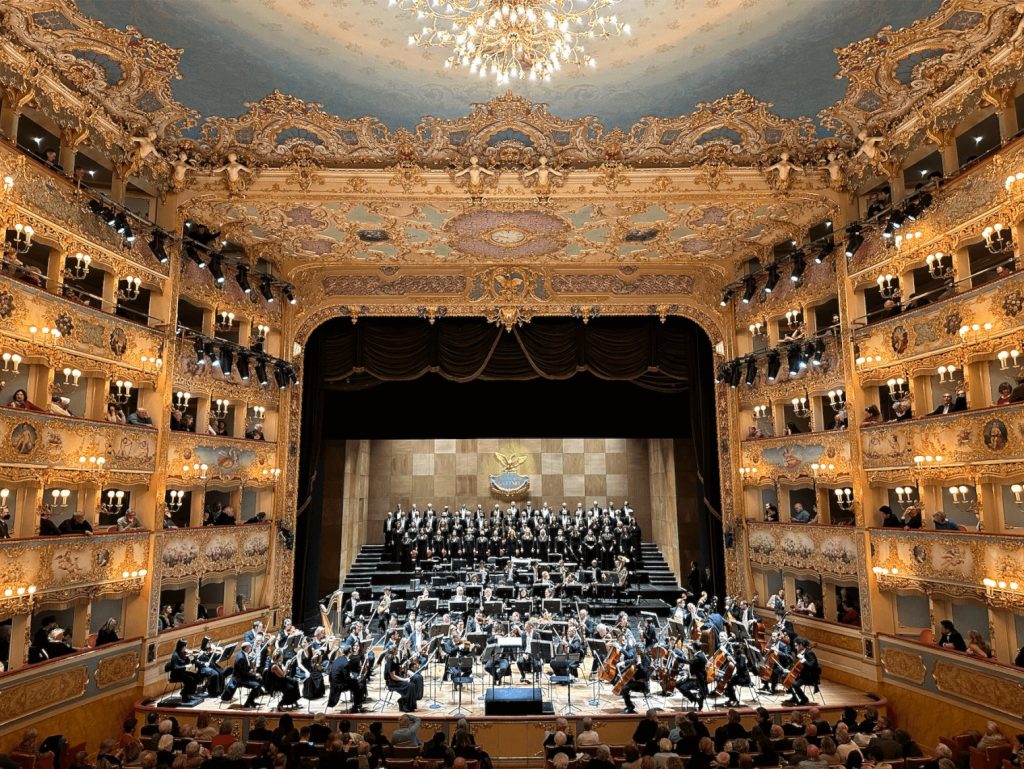
From the Guggenheim, working east through the narrow lanes of Dorsoduro and San Marco brings you to one of the most beautiful opera houses in the world.
La Fenice (The Phoenix) is the most famous opera house in Italy, and the birthplace of several of the most significant premieres in operatic history. Rigoletto and La Traviata premiered here under Verdi. Bellini’s I Capuleti e i Montecchi and Beatrice di Tenda also had their premieres at La Fenice.
The name refers to the house’s extraordinary history of burning down and being rebuilt. So it takes its name (‘The Phoenix’) from rising from the ashes of the Teatro San Benedetto, which burned in 1774 and prompted the construction of La Fenice in 1792.
The new theater, which was burned in 1836, was rebuilt and burned again in 1996 as the result of arson by electricians trying to avoid fines for delayed work. The current building is a meticulous reconstruction of the 1836 version completed in 2003.
The La Fenice Opera House + Audio Guide Ticket gives access to the main auditorium, the royal boxes, the backstage areas, and the foyer with full audio guide context. Attending a performance is the ultimate experience, and the self-guided visit is excellent when the performance schedule does not align with your dates.

Leonardo da Vinci Museum
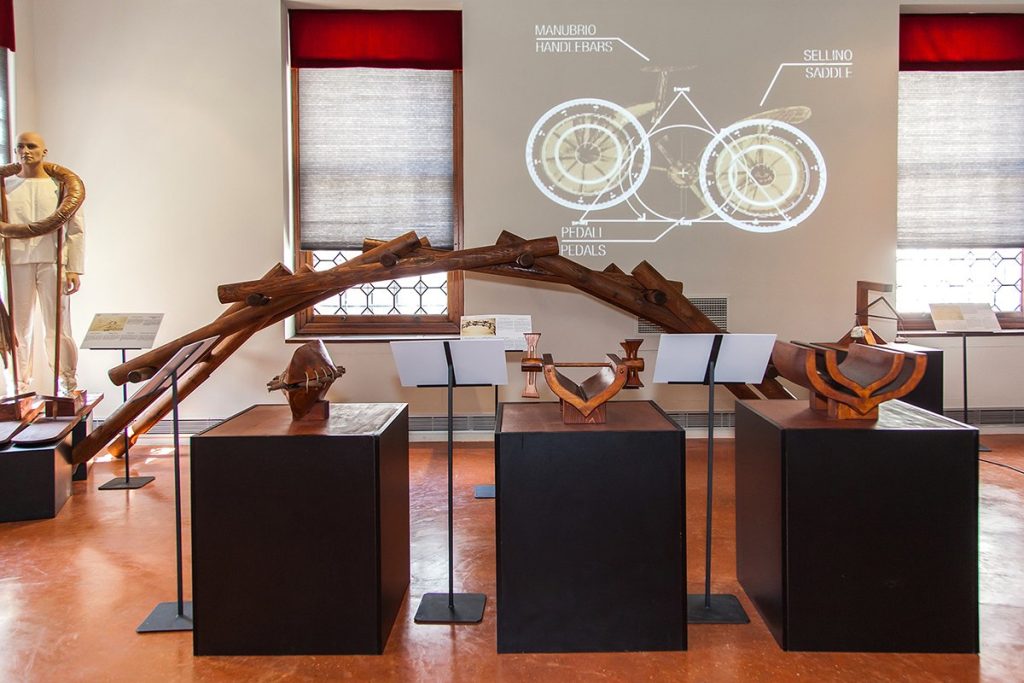
The Leonardo da Vinci Museum in Campo San Barnaba in the Dorsoduro district, housed inside the former Church of San Barnaba, is an interactive museum dedicated to the inventions, engineering concepts, and scientific ideas of Leonardo da Vinci, built entirely around working wooden models constructed from his original drawings and codices.
The collection covers over 60 machines across his major areas of invention: flying machines, including the ornithopter and aerial screw, military engineering, including the armoured vehicle and multi-barrelled cannons, hydraulic systems, and architectural mechanisms that were centuries ahead of their time.
Each model can be examined up close, and many can be physically operated by turning cranks, pulling levers, and testing gear systems, making this one of the most genuinely hands-on museums in Venice. It sits about a 10- to 15-minute walk or a short vaporetto ride from St. Mark’s Square, and works particularly well as a complement to a morning at the Doge’s Palace or the Basilica.
Where those sites show the grandeur of Venetian power and faith, the Leonardo Museum shows what the Renaissance mind was actually doing with paper and a quill. Allow an hour to 90 minutes, and consider it especially if you are travelling with children or anyone who has ever looked at a sketch and wondered what it would actually do if built.

The Outer Islands of Venice
One of the most rewarding things about Venice is that the city extends far beyond the historic centre into a lagoon full of islands, each with its own character and its own reason to visit.
- Murano, 15 minutes by vaporetto from Fondamente Nove, has been the centre of Venetian glassblowing since 1291, when the Republic moved all furnaces there to reduce fire risk in the main city. The glass factories are open to visitors, and watching the glassblowers work is one of the most impressive craft demonstrations available in Italy. The Museo del Vetro (Glass Museum) covers the full history of Murano glass from Roman times.
- Burano, 40 minutes from Fondamente Nove, is a fishing village of brightly coloured houses whose colours were originally used by fishermen to identify their homes through the lagoon fog. The island is also the centre of Venetian lacemaking, and the Museo del Merletto covers this tradition. The leaning campanile of San Martino is visible from the approach by boat.
- Torcello, 45 minutes from Venice, is the most historically significant of the islands. It is the original settlement of the lagoon, founded in the 5th century AD, and at its peak in the 10th century. It was the most populous place in the lagoon before Venice itself surpassed it and drew away its population. The Cathedral of Santa Maria Assunta, dating to 639 AD, is the oldest building in the Venetian lagoon, with extraordinary Byzantine mosaics covering the west wall with a Last Judgment of great drama and detail.
Dining in Venice
Venetian food is distinct from the rest of Italian cuisine in ways that reflect the city’s maritime history, trading connections, and the particular produce of the lagoon.
Cicchetti is the defining Venetian food experience. They are small snacks served at the counter of a bacaro (traditional wine bar) with a glass of ombra (shadow, a small pour of local wine, so named because Venetians used to drink in the shadow of the Campanile).
Cicchetti range from bread topped with salt cod (baccalà mantecato), small meatballs (polpette), sardines in sweet-and-sour agrodolce sauce, and crostini with various toppings. The cicchetti circuit around the Rialto Market and the Cannaregio bacari is the most authentically Venetian evening activity available, significantly cheaper than any sit-down restaurant, and genuinely what locals do.
Sarde in saor (sardines marinated in vinegar, onions, pine nuts, and raisins) is the most distinctly Venetian dish, reflecting the Arab and Byzantine trading connections that passed through the city for centuries. It is served at room temperature and improves after marinating for a day.
Risotto al nero di seppia (risotto with cuttlefish ink) turns the plate an extraordinary jet black and tastes of the sea in the most concentrated possible way. The cuttlefish comes fresh from the lagoon, and the dish is found at almost every traditional Venetian restaurant.
Fritto misto di mare (mixed fried seafood from the Adriatic) is the other essential, with small fish, calamari, scampi, and whatever is freshest that morning, lightly battered and fried. It is eaten at a counter or standing outside a fritto-focused osteria.
The Rialto Market on the Grand Canal operates every morning except Sunday, with the fish market (Pescheria) and the produce market (Erberia) side by side in the loggia buildings at the bend of the canal. Going early (before 9 am) and buying breakfast ingredients for a picnic on the Zattere is one of the better decisions available to a visitor in Venice.
When Should You Visit Venice?
Venice has one of the most extreme visitor seasonalities of any European city, and the timing of a visit genuinely transforms the experience.
Winter (November to February) is the secret best time. Crowds are minimal, hotel rates are the lowest of the year, the acqua alta (high water flooding) that periodically covers the lower areas of the city adds atmosphere rather than inconvenience if you have rubber boots and the right attitude, and the winter mist over the lagoon gives Venice an appearance that summer photographs cannot capture.
The Venice Carnival (Carnevale), typically in February, is the most spectacular costume event in Europe, drawing visitors from across the world for ten days of masked balls and street pageantry.
Spring (March to May) is the most popular pleasant-weather window: with temperatures ranging from 12 to 22°C, the city coming to life after winter, and crowds that have not yet reached the summer peak. April and May are the best individual months.
Summer (June to August) is extremely crowded and increasingly managed by the city with visitor quotas, the day visitor contribution, and other measures. Temperatures reach 28 to 32°C with high humidity. The city is at its most photogenic in summer light but also at its most pressured in terms of crowd density, particularly in July and August.
Autumn (September to October) has the best combination of good weather, thinning crowds, and the beginning of the cultural season. October in Venice, with the light changing and the crowds reducing, is one of the finest months to visit any Italian city.
Practical Tips Before You Go
- Check the Venice Day visitor contribution at cda.venezia.it before your visit if you are arriving without a hotel booking. The fee applies to day-trippers during peak periods.
- The Vaporetto Pass pays for itself quickly. A single vaporetto ticket is expensive, so the 24, 48, or 72-hour pass is the correct option for any visitor making more than two journeys in a day.
- Get lost deliberately. The most interesting parts of Venice are not on the route between the landmarks. Turn away from the tourist flow, find a quiet campo, and sit for a while.
- Eat cicchetti at bacari rather than sitting down at tourist restaurants near landmarks. The price difference is significant, and the quality is better.
- The Rialto Market closes around noon. Go before 9 am for the full experience and the best produce.
- Acqua alta (high water) can flood the lower areas of St. Mark’s Square and surrounding streets in autumn and winter. Elevated walkways (passerelle) are installed during flooding and rubber boots are sold throughout the city. It is manageable with preparation and genuinely spectacular to witness.
- Watch the sunset from the Zattere or the Punta della Dogana. The light on the Giudecca Canal in the evening is one of the finest free spectacles in Venice.
Venice is the city that proves architecture and water are better together than either is alone. The palaces, the churches, the bridges, the canals, the light that bounces off the water onto the undersides of bridges and through the narrow calli – all of it combines into something that painters have been trying to capture for five centuries and have never quite managed to do justice to.
Go in winter for the atmosphere, go in spring for the flowers in the campi, go in autumn for the light, and go in summer if that is what works. Just go and give it enough time.
Check out Thrillark to book your Doge’s Palace tickets, gondola ride, Vaporetto Pass, Guggenheim Museum, La Fenice, and the Eurail Pass to bring you there and take you further.
Frequently Asked Questions About Venice
Do you need a visa to visit Venice?
EU and Schengen citizens need no visa. Citizens of the US, UK, Canada, Australia, and most Western countries can visit without a visa for up to 90 days in any 180-day Schengen period. Indian nationals require a Schengen visa from the Italian Embassy. ETIAS, the EU’s pre-travel authorization for visa-exempt non-EU nationals, is being rolled out; check travel.ec.europa.eu before booking. Also check the Venice day visitor contribution requirements at cda.venezia.it if you are visiting without an overnight hotel booking.
What is the Venice Vaporetto Pass, and is it worth buying?
The Venice Vaporetto Pass gives unlimited travel on all ACTV water bus lines for 24, 48, or 72 hours, covering the Grand Canal lines, connections to Murano, Burano, the Lido, and all other vaporetto routes. Single tickets are expensive and add up quickly for visitors making multiple journeys; the pass pays for itself within a few rides and is the correct choice for any visitor spending more than a day in the city. Available through Thrillark for the best available rate.
What is the difference between the Doge’s Palace ticket options?
The standard Doge’s Palace Ticket gives full access to the palace complex including the Great Council Hall, Senate Chamber, Bridge of Sighs, and New Prisons. The St. Mark’s Basilica and Doge’s Palace Skip-the-Line Ticket adds priority entry to both the Doge’s Palace and St. Mark’s Basilica, bypassing the standard queues at both major attractions. During peak season, skip-the-line access is meaningfully different from standard entry in terms of waiting time.
What is acqua alta, and does it affect visiting Venice?
Acqua alta (high water) is the periodic flooding of Venice’s lower areas caused by a combination of high tides, strong southerly winds, and the natural subsidence of the city. It most commonly affects St. Mark’s Square and the surrounding low-lying areas during autumn and winter. When flooding is predicted, the city deploys elevated walkways (passerelle), and sirens warn residents of the level. It is manageable with rubber boots (sold throughout the city), genuinely atmospheric to experience, and not a reason to avoid visiting in winter, which is often the most beautiful and least crowded time to be in Venice.
Is a gondola ride worth it in Venice?
A gondola ride is not the most practical way to get around Venice and is significantly more expensive than the vaporetto. That said, navigating the smaller canals away from the Grand Canal in a gondola at a quiet hour of the day, or in the evening when the light is low and the canal sounds are at their most atmospheric, is a genuinely memorable experience and one that is only available in Venice. Book through Thrillark for the best available rate and consider a morning or evening departure rather than a midday ride.
What is the Eurail Global Pass, and how does it work for visiting Venice?
The Eurail Global Pass allows unlimited rail travel across Europe’s participating rail networks for a set number of consecutive or non-consecutive days within a validity period. It covers Italy’s high-speed Frecciarossa and Intercity train network, allowing travel between Rome, Florence, Bologna, and Venice without purchasing individual tickets. The Flex version allows travel on non-consecutive days within a two-month window, most useful for visitors making multiple European stops. The Family Card version covers children alongside adults. All three formats are bookable through Thrillark.
When is the best time to visit Venice?
Winter (November to February) is the best kept secret: minimal crowds, lowest hotel rates, and the atmospheric mist and acqua alta that give Venice its most otherworldly appearance. The Venice Carnival in February is the most spectacular costume event in Europe. Spring (March to May) is the most popular pleasant-weather window. Autumn (September to October) has the finest light and the best balance of good weather and manageable crowds. Summer is the most crowded and hottest period but has the longest days and the most events.
Browse by themes
Top Things to Do in Italy